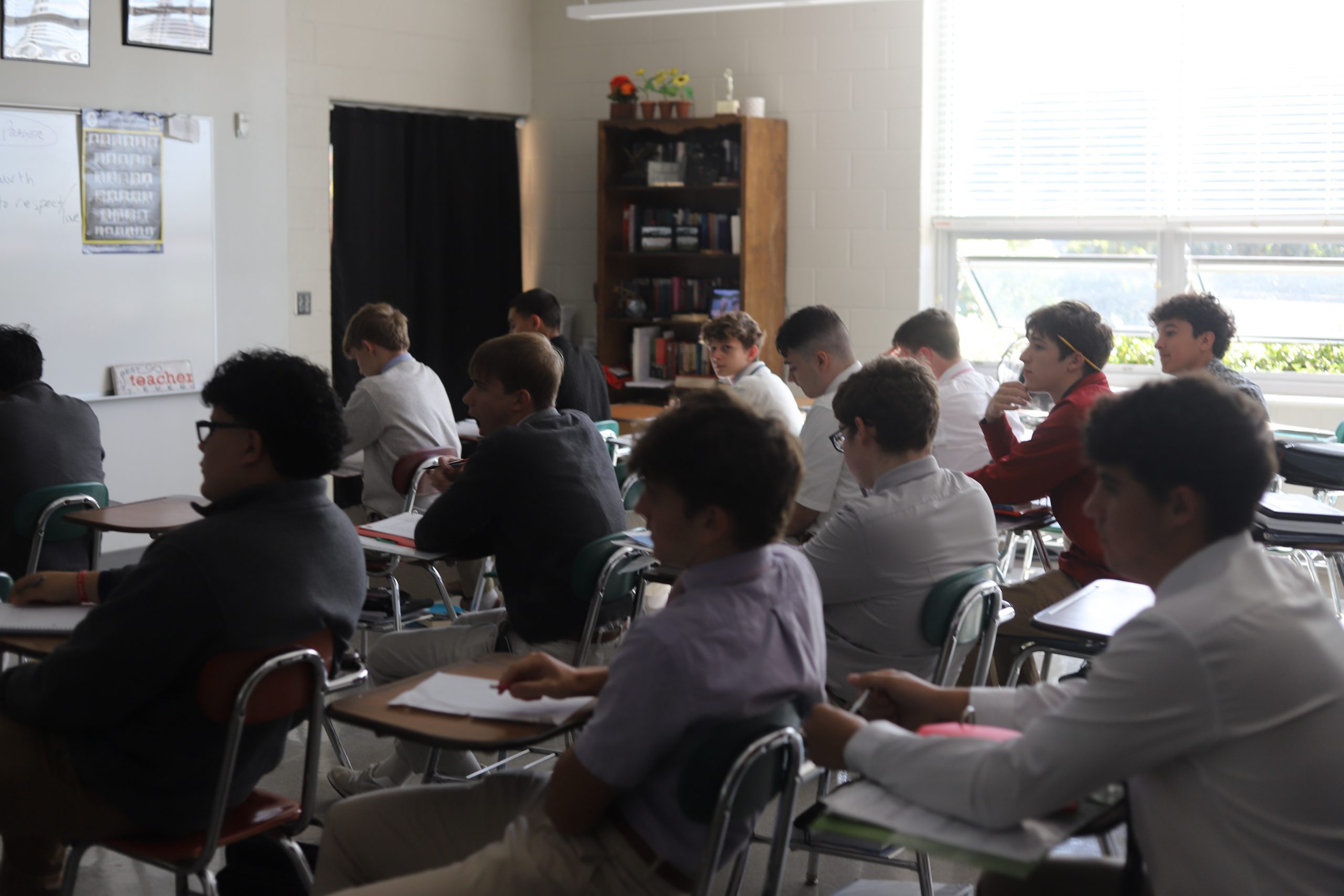
As we weigh morning rest against late dismissal, students and teachers question whether it could actually lead to more rest.
Imagine waking up an hour later for school. That could mean more sleep, more free time, more leisure, or maybe even better grades. But a later bell also means a later dismissal. Would postponing the extra morning time be worth it for a shorter afternoon?
Catholic High’s school day begins promptly at 8:05 a.m. and ends at 3:05 p.m. That’s the way it has been for almost 25 years. What would change if school started at 9:05 a.m. or even 10:05 a.m.? This would, of course, sound like a good idea, but if we compare, would the benefits outweigh the costs? Tyler Lambert ’29 said, “I would say I’d push it back a little…like not drastically long, maybe an hour.” Lambert notes extra morning time would let students get more sleep and also make students more willing to come to school. “Some people would wake up later to get more sleep, and the pushback time would also help people who live farther away,” he added.
Countless students have a long commute, so a later start could give them a buffer period to get ready for school with less stress. Nic Thornton ’27 said, “We’d probably get more study time if we moved it back.” Studying more normally affects grades and GPA overall, as people have the time to put more effort into studying effectively. In 2023, a study published in the Journal of Adolescence stated, “With our causally rigorous approach, we find that GPA is affected by school start time, but only two years after a policy change.”
When analyzing over 2,000 adolescents in their study, they found that school’s later start did, in fact, show an increase in overall GPA. However, this change was observed gradually over two years. Furthermore, Cash New ’28 said, “Getting extra sleep, too, makes you feel more rested and puts you in a better mood. And that can help with grades because you’re in this good mood. You’re willing to learn.” Rather than having low energy all day, students can approach their morning classes with energy rather than sometimes struggling to concentrate.
A Rocket Times student poll found support for a later start. Of the 466 student respondents, 52.8% of them wanted school to start later. 28.5% wanted to keep the same time, and finally, 18.7% wanted to have an earlier start time. The most popular proposed time to start school was 8:30 a.m., only 25 minutes later.
A later start, though, comes with a later dismissal time. Coach Duncan Diaz said, “All your activities, sports, and clubs would be delayed further, so you’d be getting out later. As a result of that, you’d be staying up later to complete homework and assignments.” Coach Diaz pointed out that delaying sports and clubs forces students to stay up much later to complete assignments, threatening sleep. Ms. Conyer explains, “You are supposed to have nine to ten hours of sleep every day in order for your brain to work the way it’s supposed to. So the later your day ends, the later you’re pushing that time into the evenings.” But would students actually use this opportunity and get more sleep in the morning? Coach Diaz commented, “I think you definitely would have some students that would take advantage of it, but I think you’d also have a good chunk of students that you know wouldn’t.” Many students would think, “Instead of staying up till 1:00 a.m. and going to bed, I’ll just stay up till 2:00 a.m. because I have that extra hour to sleep.”
Coach Diaz further expressed concerns about students staying up late: “We have an hour longer to sleep, then you’d stay up later, and you’d be on the video games later, or you’d be on your phones later.” Using screens right before bed ruins the benefits of the new school schedule. New emphasized the importance and consequences of sleep. “[They] still impact your grades, impact your friendships, impact who you are as a person, and your brain development,” he said.
A later dismissal could complicate athletes’ after-school lives, too. Ending school at four o’clock or even five o’clock means a two-hour practice finishes at six or seven. After practice, students still need to eat, do homework, study, and unwind. Ms. Conyer said, “We’ve done our schoolwork. We’ve done it in this time period where it’s precious. Now we get to do the physical activity that also jumpstarts our brain and our heart to keep us healthy.” But time management also plays a key role as Ms. Conyer continues, “If you’ve used your time wisely at school, technically by 5 o’clock, you’ve had a really full day, and you can have dinner, and you can rest, and do your homework in a way that’s not crammed.”
But with less afternoon time and more morning time, would it make sense to shift all sports practices to the morning too? “Doing sports in the morning could be a good thing because after you play a sport, you work out, you feel good about yourself with kind of that camaraderie with your team, and you just have the rest of the day, and then you get to go home,” New said. Coach Diaz suggested, “Maybe the freshmen and sophomores or the junior-varsity guys could come in before school to do their practice, and then once they hit the bell at 4:05, they’d be able to just go home while the older guys can start their practice.” This idea gives coaches time to focus on their younger players and athletes in the morning, then in the afternoon, focus on the older players. It could allow coaches to give players more specialized support and coaching rather than managing a team of four grades. Starting practice in the early morning could be a real solution, but most people wouldn’t want to move the start time of school earlier because the amount of sleep a student gets at night usually dictates how dialed in they are in the first period. New describes this as a domino effect: “I feel like it’s like a spiral. It starts with your morning. You didn’t really get a lot of sleep last night, and the next thing you know, you’re in religion class, and you’re not really paying attention. Then you get in trouble, and then you’re in a bad mood for the rest of your day. You’re just tired, and you want to go home, and then that just builds resentment.” All of these actions stem from not getting enough sleep. Not paying attention in religion class isn’t the choice; it’s the natural consequence of not getting enough sleep.
A later start time for school could mean a less-stressful morning. However, it activates the domino effect of events after school, forcing sports, homework, and activities later. It may just be a matter of getting used to this schedule, though, because, as Mr. Steve Straessle said, “I think our schedule mirrors what the general expectation for schools is…I think it’s a matter of just getting used to the general way of doing things in American culture and then just doing it.”